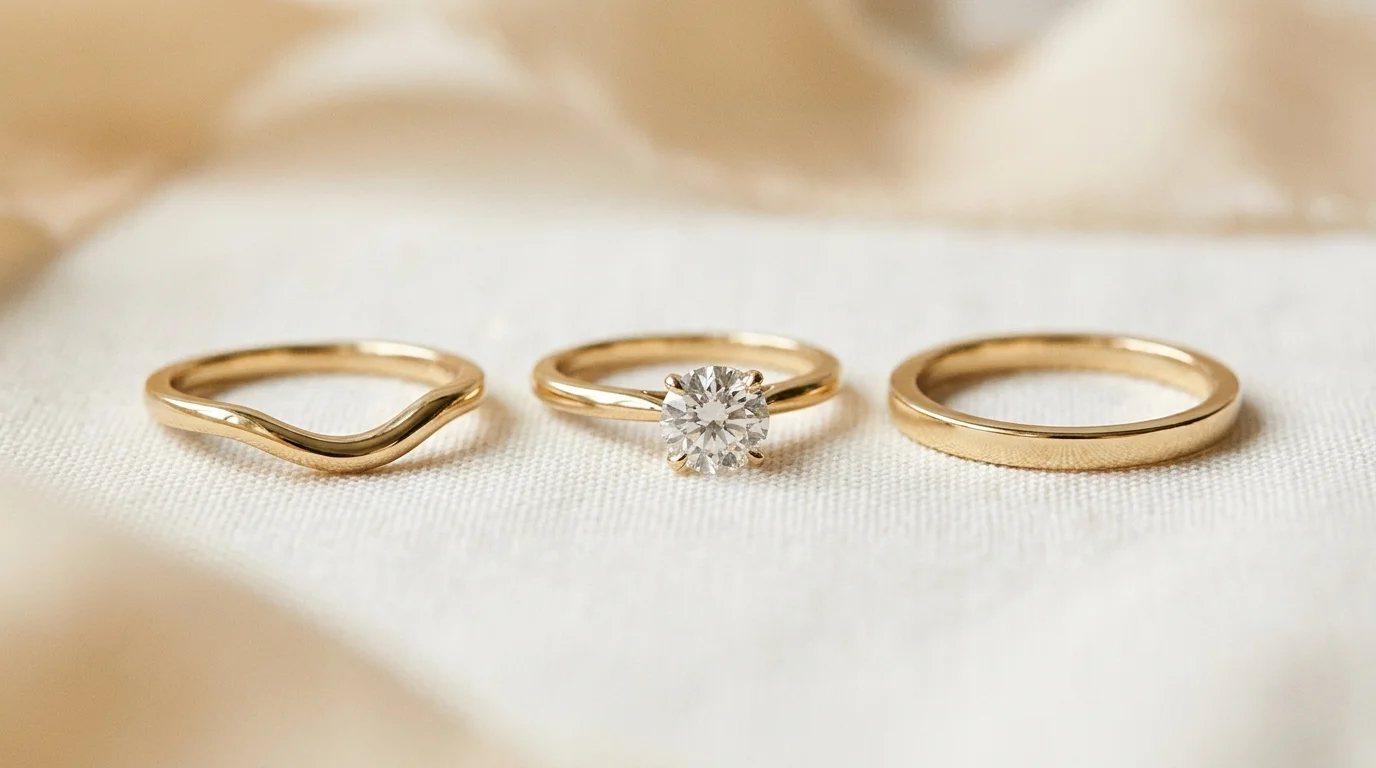
Choosing between a curved vs straight wedding band comes down to two things: how your wedding band fits beside your engagement ring and the look you want to create. A straight band offers a timeless, versatile shape, while a curved band can follow the outline of a center stone or setting that leaves a gap.
The best choice is not always the one that looks prettiest in a product photo. Understanding how the two rings sit together, whether you want to wear your band alone, and how the designs work with your engagement ring will help you choose a pairing you will love for years.
Curved vs. Straight Wedding Bands: What’s the Difference?
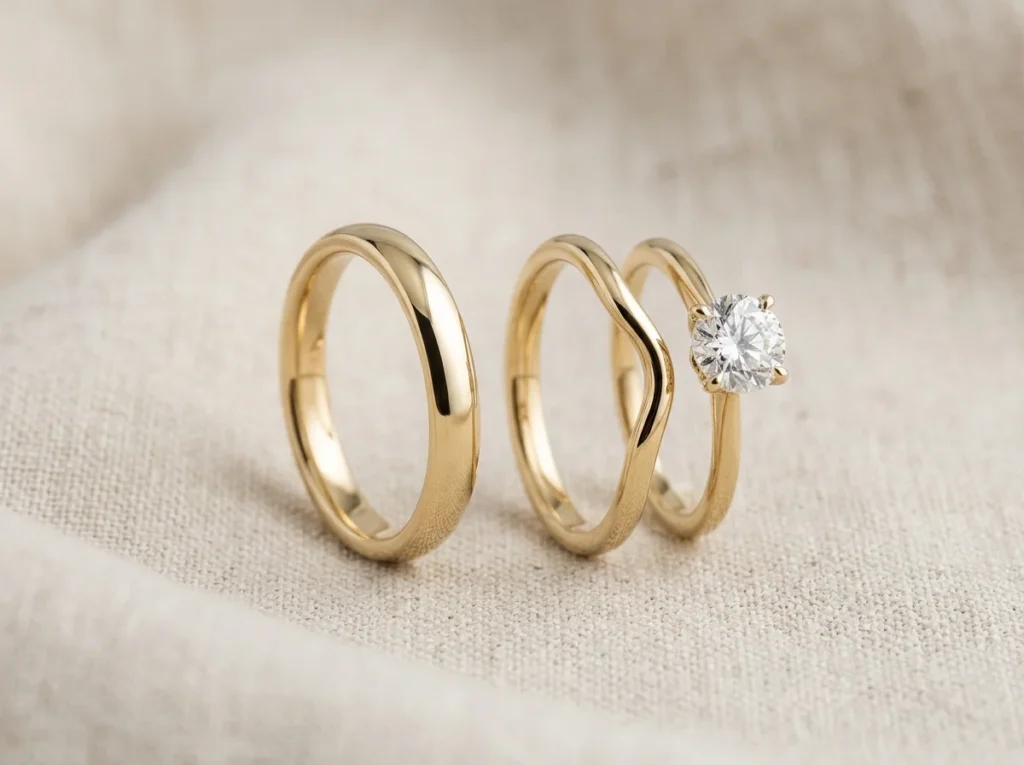
The main difference is the shape of the wedding band. A straight band follows an even line, while a curved wedding band has a shaped front designed to follow the outline of an engagement ring.
Neither style is automatically better. The right option depends on your engagement ring’s setting, your preferred appearance, and how you plan to wear the rings.
What Is a Straight Wedding Band?
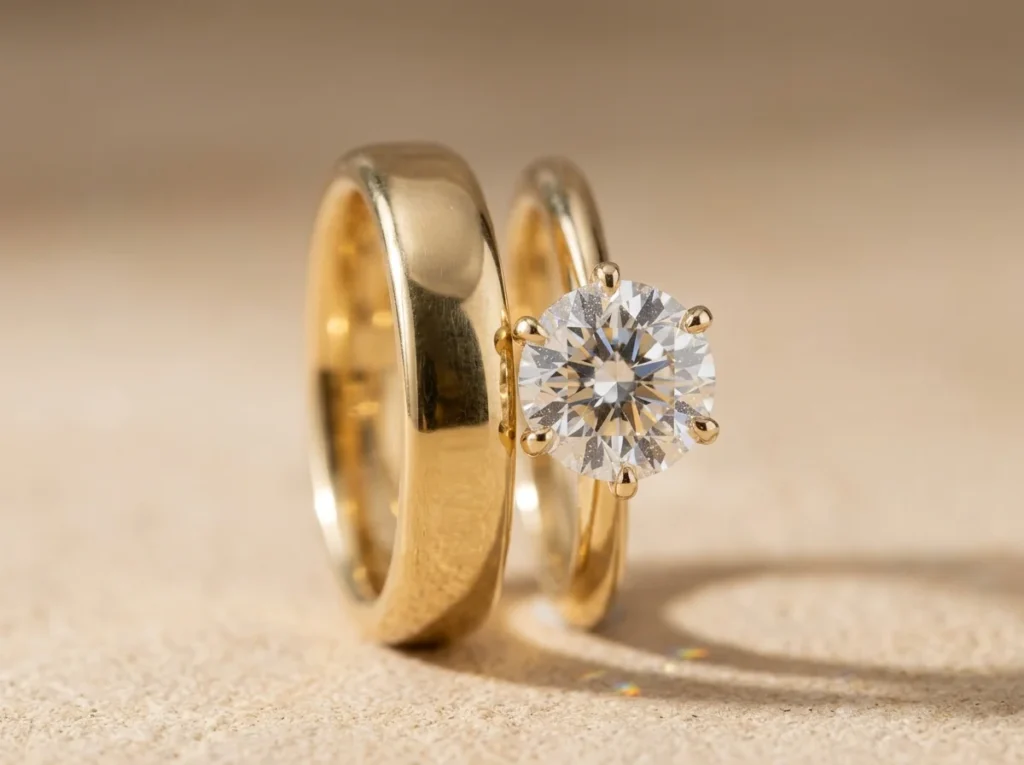
A straight wedding band has a continuous, even shape without a dip or contour designed to accommodate another ring. It can be plain gold or platinum, set with diamonds, or finished with a modern flat profile.
This style works particularly well with engagement rings that leave enough room beneath the center setting for a second band to sit alongside it. It is also a versatile choice if you want to wear your wedding band by itself or combine it with other rings later.
- Appearance: Clean, classic, and versatile.
- Best feature: Easy to style alone or in a ring stack.
- Potential drawback: May leave a visible gap beside some engagement ring settings.
What Is a Curved Wedding Band?
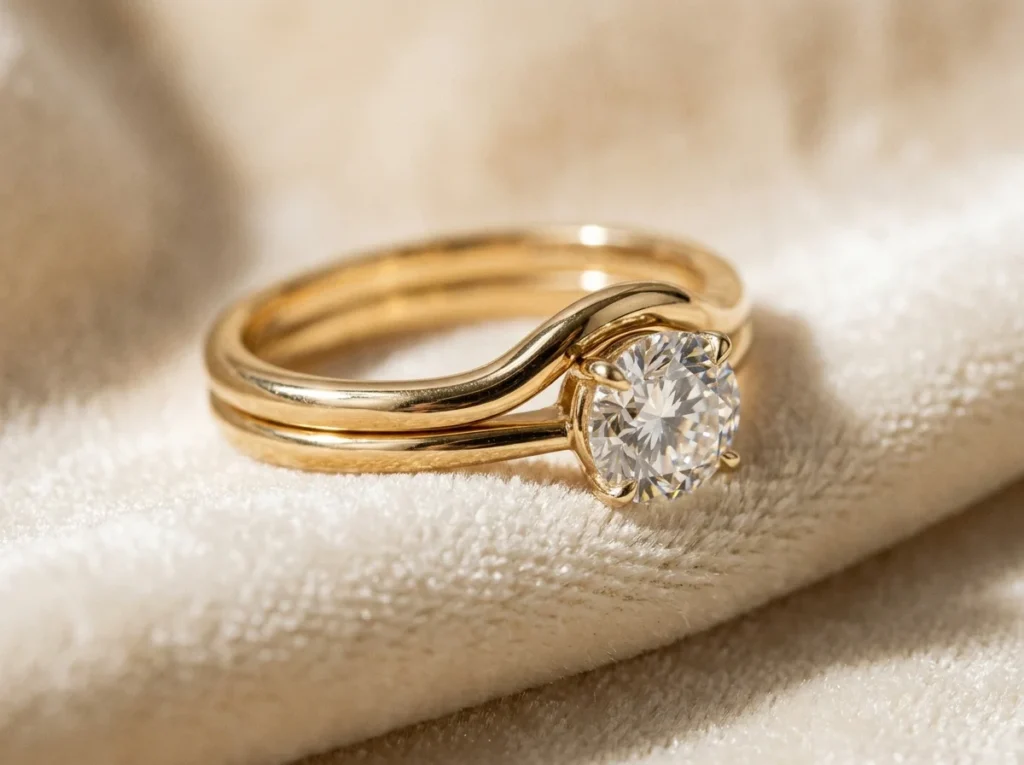
A curved wedding band, also called a contoured wedding band, has a gentle bend or shaped section that follows the outline of an engagement ring. Depending on the design, the curve may be subtle or more noticeable.
Some bands have a small notch to accommodate a setting, while others feature a V-shaped front or a flowing wave. These designs can create a close-fitting pairing when a straight band cannot sit neatly beside the engagement ring.
- Appearance: Shaped, coordinated, and sometimes more decorative.
- Best feature: Can reduce the gap between rings with incompatible profiles.
- Potential drawback: A custom contour may look less conventional when worn alone.
Curved vs. Straight Wedding Bands at a Glance
|
Feature |
Straight Wedding Band |
Curved Wedding Band |
|
Shape |
Even, uninterrupted line |
Curved or contoured front |
|
Fit beside an engagement ring |
Works when the setting provides enough clearance |
Can follow a setting that blocks a straight band |
|
Appearance when worn alone |
Usually looks natural and complete |
Shows its shaped profile |
|
Ring stacking |
Versatile for many combinations |
Best suited to compatible ring shapes |
|
Design flexibility |
Easy to pair with different styles |
Contour may be specific to one engagement ring |
|
Best starting point |
Engagement rings with sufficient clearance |
Settings that create a gap with a straight band |
The most important distinction is fit. A straight band can sit flush against many engagement rings, while a curved band can help when the center setting or stone shape gets in the way. Always check the actual rings together before deciding.
When Should You Choose a Straight Wedding Band?
A straight wedding band is a strong choice if you want a classic design that works with different outfits, occasions, and future ring combinations. It is often the simplest option when your engagement ring has enough clearance beneath its setting.
1. You Want a Timeless, Minimalist Look
A plain straight band creates a clean line beside an engagement ring without adding another prominent shape. It suits traditional solitaires, understated engagement rings, and modern designs with simple settings.
If you prefer jewelry that looks polished without drawing attention away from your center stone, a slim gold or platinum band is worth trying first.
2. Your Engagement Ring Has Enough Clearance
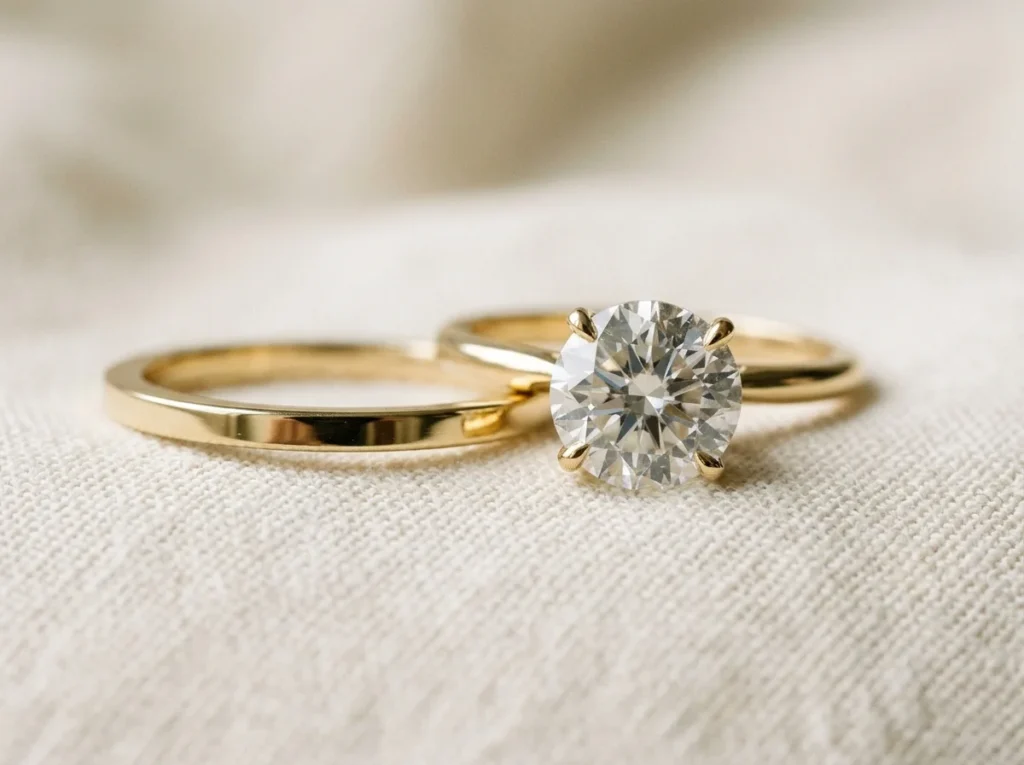
Look at your engagement ring from the side. If there is enough room beneath the center setting for a wedding band to sit beside it without pushing the engagement ring out of position, a straight design may work beautifully.
Some raised solitaire and cathedral settings provide this clearance. However, the setting’s construction matters more than its style name, so test the actual pairing rather than relying on appearance alone.
3. You Want to Wear Your Wedding Band Alone
A straight band usually looks balanced on its own because its shape does not depend on another ring. You can wear it during everyday activities, on trips, or whenever you prefer a simpler look.
If wearing the band alone is important to you, consider a classic polished finish, a subtle brushed texture, or a small diamond detail that works independently of your engagement ring.
4. You Like Changing Your Ring Stack
A straight wedding band offers flexibility if you might add an anniversary band or another ring later. Its even outline can make it easier to combine different designs without needing every ring to follow one specific contour.
Still, check the width, height, and stone settings of the rings you plan to stack. Two rings can look compatible from above but rub against each other when worn together.
When Should You Choose a Curved Wedding Band?
A curved wedding band is worth considering when your engagement ring’s shape prevents a straight band from sitting close beside it. It can also be the right choice when you want the two rings to form a coordinated, flowing design.
1. Your Engagement Ring Leaves a Visible Gap
If a straight band stops against the center setting and leaves an open space between the rings, a curved band may follow the setting more closely. This is especially useful when the engagement ring’s lower structure extends toward the finger.
A properly fitted contour can create a more connected appearance without requiring you to change the engagement ring you already love.
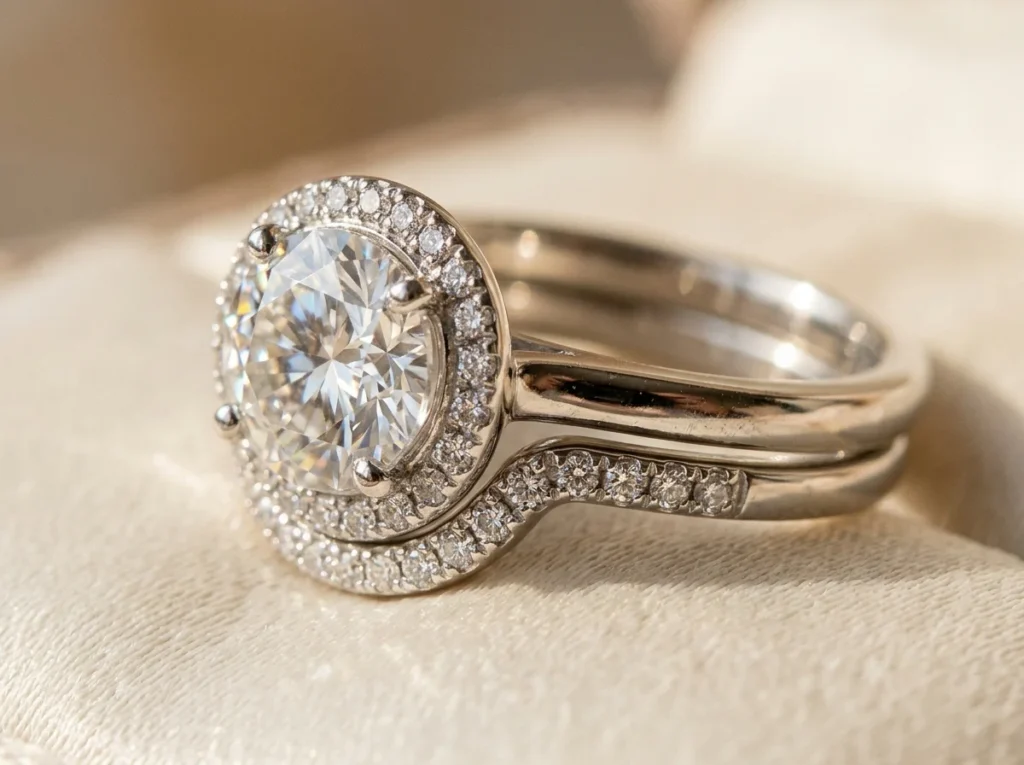
2. You Have a Halo or Low-Set Engagement Ring
A halo surrounds the center stone with smaller diamonds or other gemstones. Depending on the halo’s shape and how low it sits, its outline may prevent a straight band from meeting the engagement ring neatly.
A low-set ring can create a similar problem when its setting occupies the space where a straight band would normally sit. A curved or notched design may provide a closer fit, but the exact shape must match the setting.
3. You Have a Pear or Marquise Center Stone
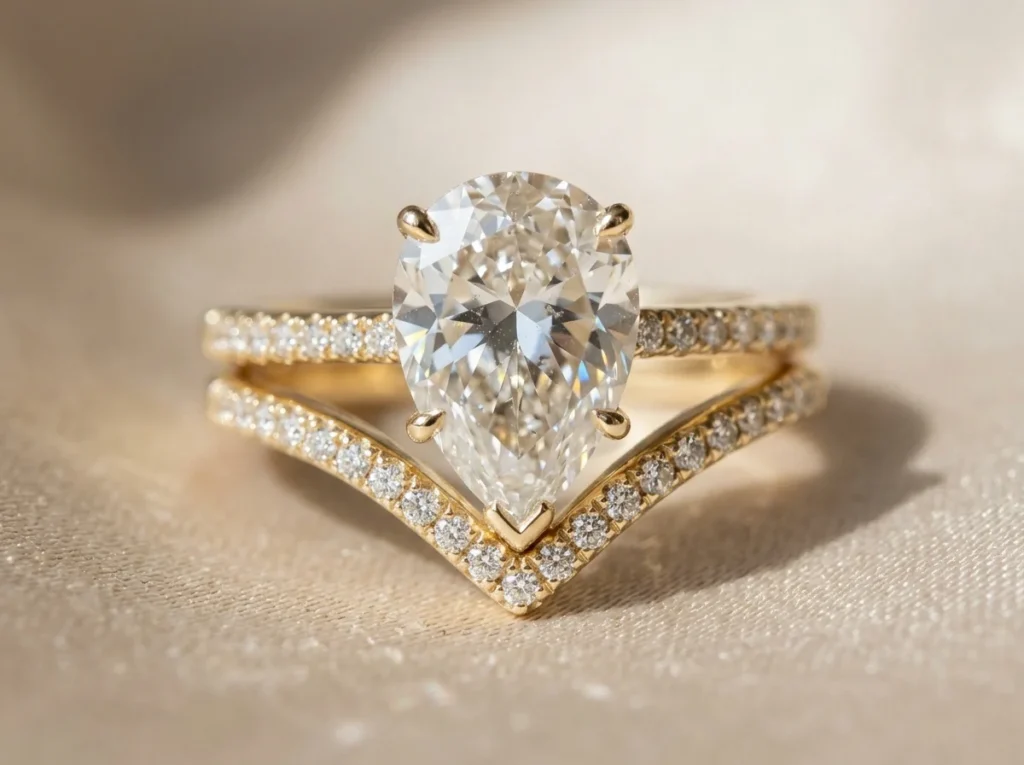
Pear-shaped and marquise engagement rings have pointed ends that can extend beyond the area where a straight band naturally meets the ring. A contoured band can follow these outlines and create a more intentional pairing.
For a pear-shaped stone, an asymmetrical contour may be needed. A marquise setting may call for a deeper or more carefully shaped curve, depending on the stone’s orientation and setting.
4. You Want a Coordinated Bridal Set
A curved wedding band can make an engagement ring and wedding band look as though they were designed together. The contour can echo the center stone, frame the setting, or create a distinctive silhouette when the rings are worn as a pair.
This is a particularly useful option if you prefer a close-fitting ring stack over the look of two separate bands. Ask a jeweler to check the design from above and from the side so the finished pairing looks balanced from different angles.
Which Engagement Ring Shapes Work Best With Each Band?
The center stone’s shape can offer a useful starting point, but it does not determine the answer by itself. The setting’s height, basket, gallery, and overall construction all affect whether a straight band will fit.
|
Engagement Ring Style |
Band to Try First |
What to Check |
|
Round solitaire |
Straight |
Clearance beneath the center setting |
|
Oval solitaire |
Straight or curved |
Stone overhang and setting height |
|
Pear-shaped diamond |
Curved or notched |
Space around the pointed end |
|
Marquise diamond |
Curved or shaped |
Clearance beneath both pointed ends |
|
Halo engagement ring |
Straight or curved |
Whether the halo blocks the band’s path |
|
Low-profile setting |
Often curved |
Room between the setting and finger |
|
Emerald-cut solitaire |
Straight |
Setting clearance and band width |
|
Three-stone ring |
Straight or contoured | Side-stone placement and ring structure |
Use this table as a starting point rather than a rule. Two engagement rings with the same center stone shape can need different wedding bands because their settings are built differently.
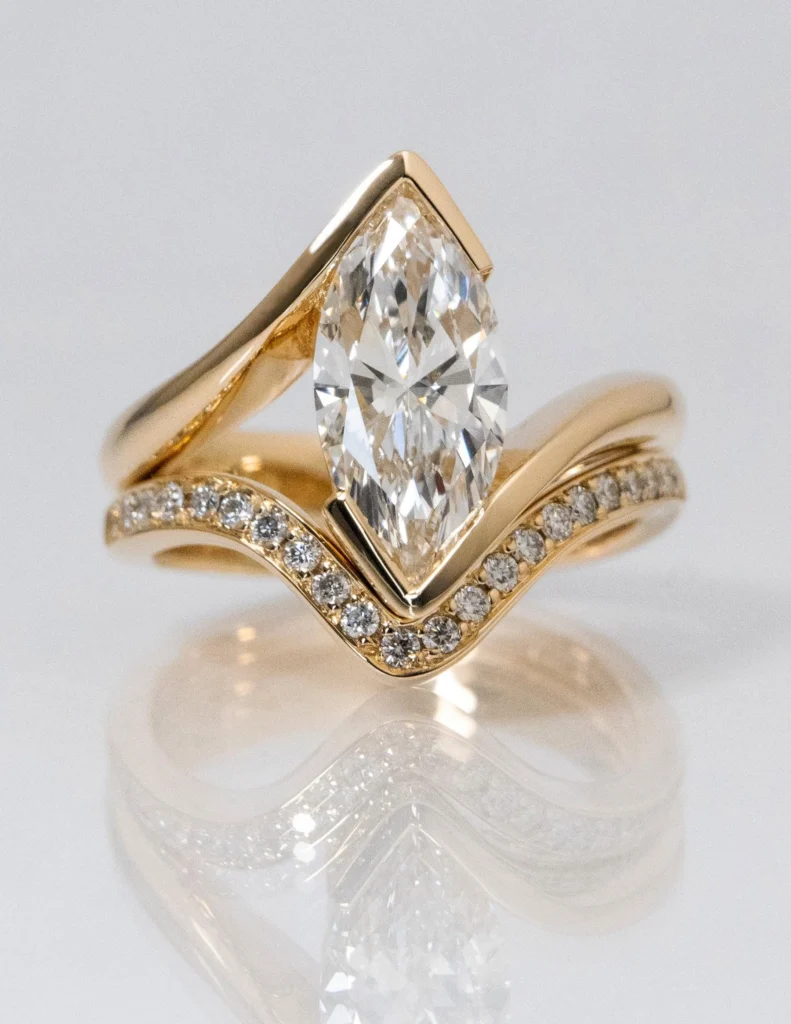
Curved vs. Straight Wedding Bands: Which Looks Better?
Once you know which shapes can fit your engagement ring, consider the look you want. Both options can be elegant, and neither is inherently more modern, romantic, or luxurious.
For a Classic Bridal Look
A straight band creates a traditional pairing with a clear, uninterrupted outline. A polished yellow-gold band beside a solitaire, for example, keeps the overall design simple and balanced.
White gold or platinum can create a similar understated look. Choose the metal and finish that complement your engagement ring and personal style.
For a Seamless, Fitted Look
A curved band can follow the shape of your engagement ring and make the two pieces appear more closely connected. The result may look particularly cohesive when the contour echoes the center stone or the outline of a halo.
Remember that a close fit is not always necessary. A small gap can be an intentional design choice if you like the separation or prefer the flexibility of a straight band.
For a Modern or Statement Look
A straight band can create a bold contrast with a detailed engagement ring, particularly if you choose a wider profile or a flat finish. A curved or chevron band can introduce a distinctive line that frames the center stone.
Try different widths and finishes before settling on a design. A band that looks delicate in a product image may appear much wider beside your engagement ring, while a highly decorative contour can compete with an elaborate setting.
What About Comfort and Everyday Wear?
Comfort depends on more than whether a band is curved or straight. Its width, thickness, inner shape, metal finish, and fit on your finger all influence how it feels throughout the day.
- Check the edges: Smooth, well-finished edges can make a band more comfortable for everyday wear.
- Compare widths: A wider band can feel tighter than a narrower band of the same ring size.
- Test the pairing: Make sure the two rings do not press against each other or force the engagement ring to tilt.
- Check for movement: Notice whether either ring spins or shifts when you move your hand naturally.
- Consider your routine: Choose a design that feels practical for your work, hobbies, and preferred level of jewelry maintenance.
A curved band is not automatically more comfortable because it fits closely, and a straight band is not automatically easier to wear. Try the finished combination on your finger and assess how it feels as a pair.
Can You Wear a Curved Wedding Band on Its Own?
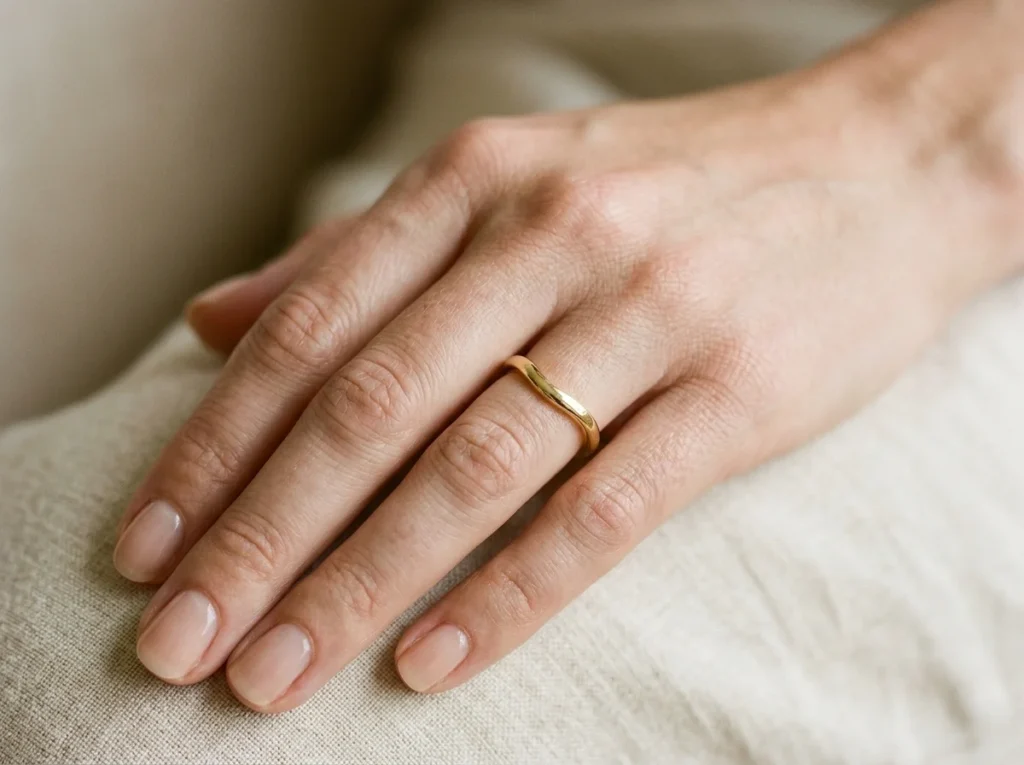
Yes. You can wear a curved wedding band without an engagement ring, but its appearance will depend on how pronounced the contour is. A gentle curve may look subtle, while a deep notch or V-shaped front can make the band’s shape more noticeable.
If you expect to wear your wedding band alone often, compare it both ways before buying. A straight band is usually the more versatile choice, but a curved band can still be beautiful as a standalone ring if you enjoy its design.
Can You Wear a Straight Wedding Band With a Gap?
Absolutely. A straight band does not have to sit flush against an engagement ring to look intentional. Some people prefer a small gap because it preserves the shape of the engagement ring and allows each piece to stand out.
The important distinction is between a gap you choose and one that creates an uncomfortable or unstable fit. If the rings rub, tilt, or catch on each other, ask a jeweler to assess the combination before wearing them together every day.
You also do not have to replace your engagement ring to get the look you want. A straight band with a deliberate gap may be a practical alternative to commissioning a custom contour.
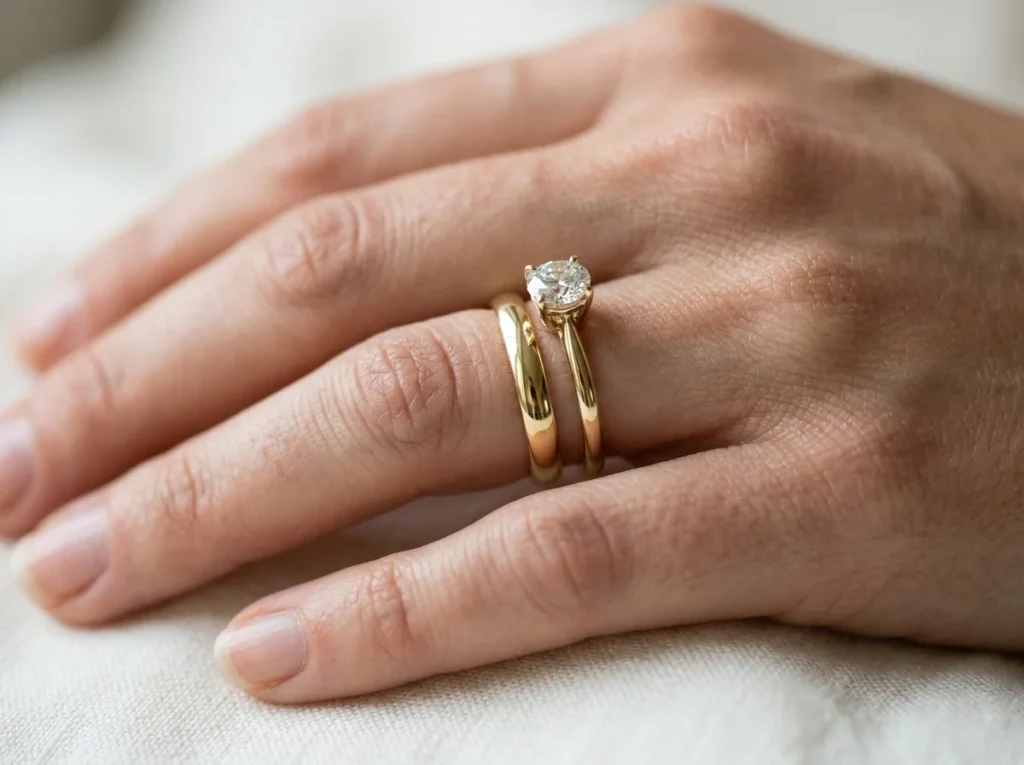
How to Choose the Right Wedding Band for Your Engagement Ring
Before purchasing either style, follow these steps to narrow down your options.
- Bring your engagement ring. If you already own it, use the actual ring when comparing wedding bands. Photos do not always show the clearance beneath the setting.
- Try a straight band first. Check whether it sits comfortably beside the engagement ring without pushing it out of position.
- Look for gaps from the side. A top view can hide the space between the bands. Check how the rings meet at finger level.
- Try a curved alternative if needed. Compare the contour against your setting to see whether it improves the fit.
- Compare band widths and finishes. Test different proportions and metal colors to find a balanced pairing.
- Wear the combination briefly. Move your hand naturally and check for rubbing, pinching, or excessive movement.
- Confirm your ring size. Have the fit checked before ordering, especially if the band is wide or the design is custom-made.
If you are shopping online, check the seller’s sizing, return, resizing, and custom-order policies before purchasing. A band that looks right on a screen may not fit the shape of your engagement ring in person.
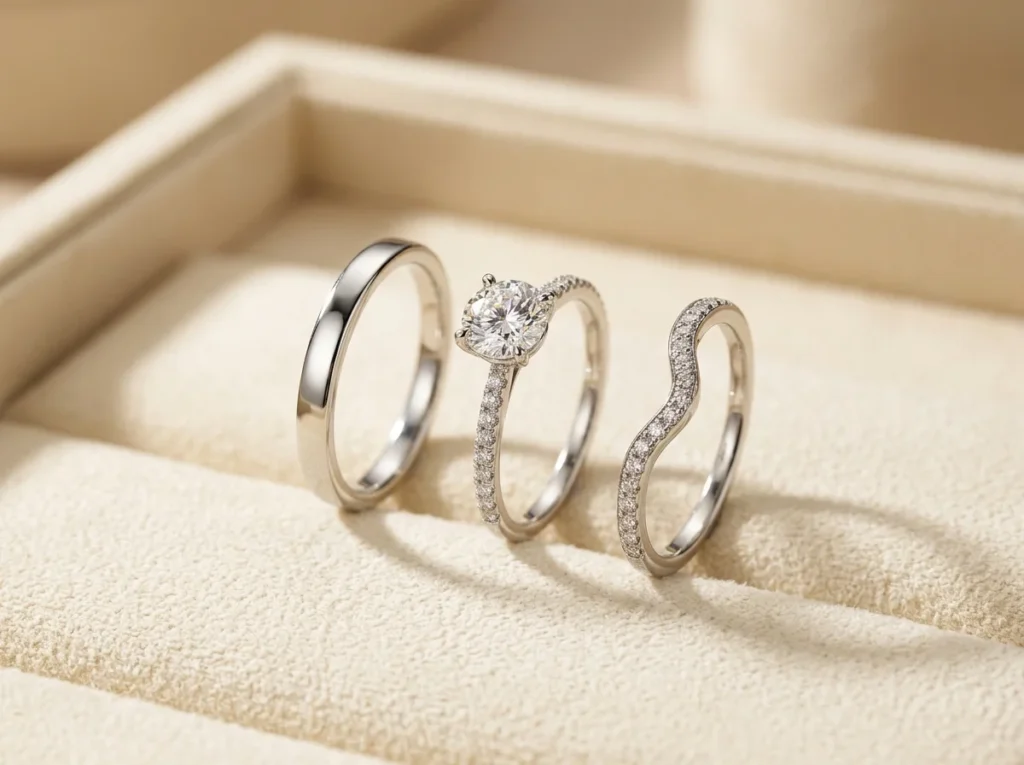
Should Your Curved or Straight Wedding Band Match Your Engagement Ring?
Your wedding band does not have to be identical to your engagement ring. Matching the metal color and finish can create a coordinated look, while mixing finishes or using a different metal color can add contrast.
For example, a yellow-gold straight band can look striking beside a white-metal engagement ring, while a curved band with small diamonds can complement a more detailed setting. The important thing is that the rings sit comfortably together and create the appearance you prefer.
Also consider how the rings will wear against each other. If the setting or diamonds of one ring rub against the other, ask a jeweler whether the pairing needs a different profile or additional spacing to reduce unwanted contact.
Common Mistakes to Avoid
Choosing Based Only on Appearance
A ring pairing can look beautiful in a photograph but fit poorly in real life. Always check the actual setting and how the two bands meet before placing an order.
Assuming Every Oval or Halo Needs a Curved Band
Stone shape and setting style offer clues, not guarantees. Some oval and halo rings work well with straight bands, while others need a contour. Test your particular ring rather than relying on a general rule.
Forgetting How the Band Looks Alone
If you plan to wear your wedding band by itself, consider whether its shape still appeals to you without the engagement ring. This matters most when choosing a pronounced curve or notch.
Ignoring Width and Proportion
A very wide band can overwhelm a delicate engagement ring, while a very narrow one may look out of proportion beside a larger setting. Compare the rings together to find a combination that feels balanced.
Ordering a Custom Contour Without Checking the Fit
A shaped band may be designed around the outline of a specific engagement ring. Confirm the measurements and fitting process with the jeweler, especially if the engagement ring could be altered or replaced later.
Frequently Asked Questions
Is a curved wedding band better than a straight one?
Neither is universally better. A straight band is versatile and works well when the engagement ring provides enough clearance, while a curved band can fit more closely around settings that would leave a gap with a straight design.
Does a curved wedding band prevent a gap?
It can reduce or eliminate a gap when the contour is designed to match the engagement ring. The result depends on the exact setting and band shape, so have the pairing checked before purchasing.
Can I wear a straight wedding band with a low-set engagement ring?
Sometimes, but it depends on how much room exists beneath the setting. If the center structure blocks the band, a curved or notched design may fit better.
Are curved wedding bands harder to resize?
Resizing depends on the ring’s metal, construction, stone setting, and contour. A simple band may be easier to adjust than an intricate design, so ask your jeweler about the specific ring before ordering.
Can I mix gold colors between my engagement ring and wedding band?
Yes. Yellow gold, white gold, and rose gold can be combined for a contrasting look. Ask a jeweler to check the fit and how the rings contact each other, particularly if their settings or finishes differ.
Should my wedding band sit flush against my engagement ring?
No. A flush fit is a preference, not a requirement. Some people like the clean appearance of two rings sitting closely together, while others prefer a deliberate gap between their engagement ring and wedding band.
Final Verdict: Curved vs. Straight Wedding Bands
Choose a straight wedding band if you want a timeless, versatile design and your engagement ring allows it to sit comfortably beside the setting. Choose a curved wedding band if you want a closer-fitting outline around a setting that leaves a gap with a straight band.
Before deciding, try both styles with your actual engagement ring, compare their proportions, and consider whether you will wear the band alone. The best wedding band is the one that fits comfortably, complements your ring, and feels right for your everyday life.
Join the Conversation